

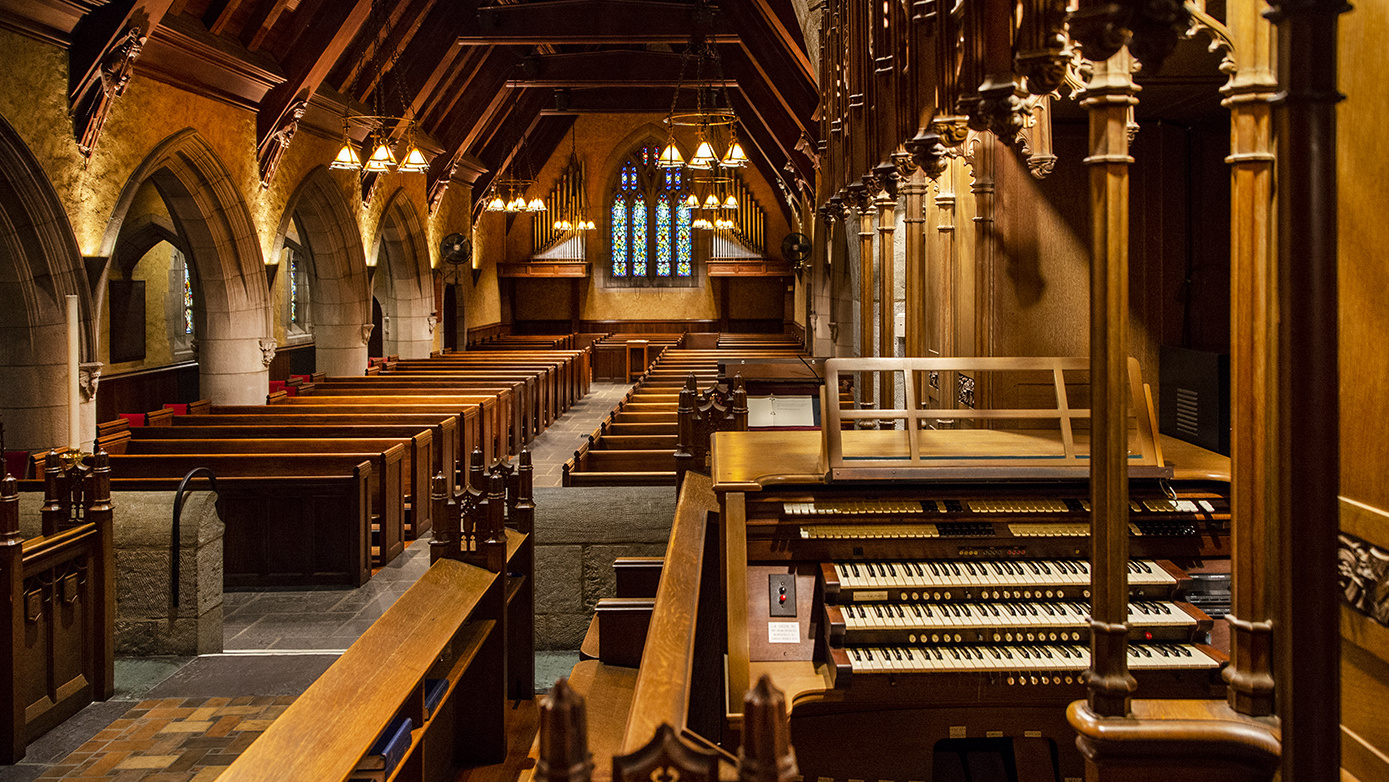
The original organ was built for the new church in 1928 by the Hall Organ Company from West Haven, Connecticut. The organ pipes are housed in a special alcove, known as the organ chamber, that was built specifically for the organ. The organ chamber actually forms a distinctive part of the exterior architecture of our church as it extends out from the main structure toward Church Street. It also extends down to the basement level of the church, and up to the roof. The organ console, where the keyboards are, is located across from the organ chamber, behind the choir stalls.
In the 1970s and ’80s, some major improvements were made to our instrument. The Hall organ had an attractive but very mellow tone, and since there were no pipes in the back of the church, the congregation had a hard time hearing the organ during hymns. The pipes on the back wall of the church (the Antiphonal Division) were acquired from First and Central Presbyterian Church in Wilmington, to aid in congregational singing. A similar set of pipes was installed in the organ chamber in front, adding much needed volume and brilliance to the organ’s sound. Some mechanical parts of the organ were replaced or upgraded, and a used organ console, built by the Austin Organ Company, was brought in from another church to replace the original Hall console.
Over time, new mechanical problems began to plague our pipe organ. Most notably, notes would sometimes not play due to bad electrical connections in the organ console, and leaks under the organ pipes made parts of the organ unplayable. In addition, the organ console used a noisy, inefficient mechanism that was decades out of date; the wind supply to the pipes was unstable and inadequate; and the swell shades (shutters that open and close to control volume) regularly malfunctioned. There were also problems with the organ’s sound. For example, the old and new pipes didn’t blend together well, and, for an instrument of its size, there was a surprising lack of variety in sound or tone.
The Organ Renovation
In 2013, organ technician Charles W. Gibson and Director of Music Vernon Williams collaborated on a comprehensive plan to repair and improve the instrument in practical ways so that it would be reliable and would better be able to lead hymn singing, accompany anthems, and serve as a recital instrument. The plan was to rebuild the console to incorporate current digital technology, fix the wind chests and wind supply, broaden the scale of the Principal choruses and revoice them to be softer, add some new stops to give the organ more color, and make a host of smaller but significant changes to the tonal design.
In 2014, the Vestry embarked on a $250,000 capital campaign to raise money for the renovation. With a theme of “Inspiring Worship for Years to Come,” the capital campaign was a success, and a total of almost $260,000 was pledged or donated.
The console was rebuilt in the summer of 2014; many repairs and alterations were made throughout 2015; and in 2016 the new organ pipes were completed and installed. The project’s goals were achieved: the organ is reliable, the old and new stops blend well together, and there is a richness and variety of tone that was missing before.
In September, 2015, the renovation project was dedicated to the memory of Andrew Stowell, son of Susan and The Rev. Philip Stowell, who was Rector when Andrew died suddenly in August 2014. A plaque commemorating this dedication is on the wall near the entrance to the organ chamber, next to the pulpit where Fr. Stowell preached for twenty years.