

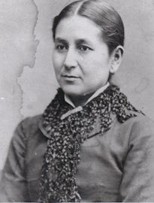
The Haudenosaunee Convention that we described last week was one of many models of how tribal governance afforded women active and full participation in their functioning. Sadly, however, even after the Nineteenth Amendment was ratified, in 1920, states continued to deny Native men and women suffrage. This however is only part of the tragedy of the story of our first Americans. After the colonists and “civilization” arrived, the US government systematically sought to deny Native Americans their customs, lands, language, and culture. Native populations were pushed from their homelands and confined to reservations which were often barren, harsh regions with few resources.
Because of this unfair treatment, many Native women devoted their energies to preserving their tribal customs and homelands. But, in addition, many also became deeply engaged in the national battle for women’s rights. One such prominent woman was Susette La Flesche Tibbles. Born in 1854, Susette was a member of the Omaha tribe in what is now the state of Nebraska. Also known by her tribal name, Inshata Theumba, which means “Bright Eyes,” Susette was born to a family of mixed ancestry that greatly valued education. Her father, who was the tribe’s chief, encouraged Susette to learn not only the Omaha language bur also English because he understood that she would need to be bilingual to thrive in the new America. Her many talents were nurtured by her family and combined with her diligent nature and a good education at mission and private schools, she developed a talent to communicate effectively. She would later become a successful writer, lecturer, interpreter, artist, teacher and eloquent advocate for the rights of women and all Native Americans.
Upon graduation, Susette became a teacher on an Indian reservation and witnessed firsthand the hardships experienced by native families – the poverty, lack of resources and employment opportunities and inadequate food and health care. Her awareness of the needs of her community became even more focused after she served as an interpreter for Standing Bear, the chief of the Ponca Tribe, during his trial. The government had forced the Ponca tribe to leave their homeland in Nebraska and relocate to Indian Territory in Oklahoma where conditions were poor, malaria was endemic, and the promised government supplies were delayed and insufficient for farming. Many Ponca, including Standing Bear’s oldest son, died due to the poor conditions and lack of food and medical care. When the Chief left the Indian Territory with some followers to bury his son in Nebraska, they were all arrested. Thomas Tibbles, a newspaper editor was among the many who saw this as unjust and encouraged the Chief to litigate the matter. Because the Chief did not speak English, Susette agreed to act as Standing Bear’s interpreter during the law suit. The case, Standing Bear v. Crook (1879), held that Native Americans were “persons” and citizens under the US Constitution and under the law. As such, Standing Bear possessed the right to challenge his detention. After playing an important role in this landmark case, Susette began serving as a witness and interpreter in many other cases concerning the rights of Native peoples.
Following the trial, Susette, her brother Francis, Standing Bear, and journalist Thomas Hennry Tibbles whom Susette would later marry, traveled throughout the eastern United States and eventually abroad to speak about the treatment of Native Americans, including the loss of their lands and the government’s failure to respect their rights. She also appeared before congressional committees advocating for the rights of Native people. Susette wrote many newspaper articles advocating for the rights of Native Americans, and extensively covered the conditions on various reservations as well as the Wounded Knee massacre. She also wrote and illustrated several books for adults and children about Native Americans.
Although Susette is not always included in traditional histories of the women’s suffrage movement, her activism was connected to both the fight for autonomy and dignity for Native peoples which included the broader struggle for women’s political and civil rights. The fight for suffrage has always also been part of the larger struggle for equality, citizenship, self-determination, and the rights of all people, including Native men and women, to find their own voice and shape their own lives.
For the past few months, the members of the God’s Diversity Committee have recognized lesser-known women, of different cultural backgrounds, who were important to the suffrage movement. This Sunday, we wish to celebrate an important place with a unique cultural history that has significance to both Native Americans and those who fought for women’s rights.
On July 14, 1848, a newspaper advertisement and many flyers posted around the town of Seneca Falls, New York, announced the upcoming “Convention to discuss the social, civil, and religious condition and rights of women.” A few days later, over three hundred women and men gathered in a local church and after impassioned speeches and countless conversations, one hundred people signed a document that some believe formally began the women’s suffrage movement. This document, which came to be known as the Declaration of Sentiments, was modeled on the Declaration of Independence, but added two simple words to its predecessor’s most famous passage: “All men and women are created equal.” The parts of the Declaration of Sentiments demanding total equality for women in economics, family life, and religion, had been a work in progress for many years by well-known social activists like, Elizabeth Cady Stanton, its primary author. But its final iteration included an equal right to vote. This last demand was considered so radical that many supporters, including Lucretia Mott, opposed it, fearing it would jeopardize the other important rights women were seeking. Supporters persisted however, and the right to vote became the centerpiece of this new phase of the women’s rights movement. One wonders if the history of the place where the conference was held had anything to do with the group’s bold new approach.
At the time of convention, the town of Seneca Falls was located in the territory of the Haudenosaunee, a confederacy of six Native American nations, and which today is considered part of upstate New York. What is most interesting is the Haudenosaunee, also known as the Iroquois Confederacy, was a matrilineal society that practiced a form of representative democracy and gave significant power to women. Women played important roles in decisions concerning land, agriculture, family life and community welfare. Women not only farmed the land but also made important decisions of how it was to be farmed. They kept their own property after marriage. They held veto power over decisions about war and peace and clan mothers had important responsibilities including selecting and advising male chiefs and when necessary, removing chiefs who failed to serve their communities properly.
It is difficult to gage how much influence the example of the Haudenosaunee community had on the suffragists. We know that Elizabeth Cady Stanton and Matilda Joslyn Gage lived near Haudenosaunee land and may have had opportunities to observe women’s social and political roles in these communities. We also know that Gage wrote extensively about the political freedoms, independence and authority enjoyed by Haudenosaunee women and saw them as a model that all American women could emulate. Stanton also wrote about Indigenous women and their status.
That is not to say that Native American women of the Seneca area became more than merely a powerful inspiration to some suffragists or that they joined or were even welcomed into the movement. To many suffragists, especially during these early years, native women would always remain unfamiliar and outside their movement. Some also feared that enlarging the scope of their mission to include native women would dilute any benefits gained and even undermine their primary objectives. At the same time, Haudenosaunee women had their own goals and priorities. They were fighting to protect their people’s independence and way of life, which wasn’t about women ruling men, but about sharing responsibilities, safeguarding their traditions, and protecting their families, essential work that continues today. But the goals of the suffragists and the example of the Haudenosaunee women may very well have served as catalysts to their respective causes. Their stories could only help to replenish the courage and perseverance needed by each group to achieve their goals and realize their missions. One can only imagine that if these culturally disparate groups had the opportunity to work more closely together, they would have undoubtedly come to admire the possibilities and hope each represented and inspired.
As we begin our celebration of Native American Heritage Month, the members of the God’s Diversity Committee invite our Trinity community to join us in prayer:
O God of infinite mercy, we live in a land where the native peoples were moved, often by force, from the bountiful lands they inhabited to places of desolation. Help us to support them now as they seek to retain their rich native cultures. Open our eyes to the poverty and despair that so often accompany them through life, and give us the courage and will to change the systems that perpetuate injustice, for the sake of your Son our Lord. Amen
Episcopal Diocesan Commission to End Racism